7 Common Mistakes That Spread Deadly Contamination During Sewage Cleanup (And What Delaware County Homeowners Should Do Instead)
Can I Clean Up Sewage Backup Myself or Do I Need Professional Help?
Updated January 2025
Let’s be direct: No, you cannot safely clean sewage backup yourself.
Sewage contains bacteria, viruses, parasites, and pathogens that cause serious illness and even death. Unlike clean water damage where you might safely mop up a small spill, sewage is classified as Category 3 “black water” – the most dangerous contamination level. There is no “small” sewage backup that’s safe for DIY cleanup.
If you’re dealing with sewage backup right now in Delaware or Chester County, call Restore More at (484) 699-8725 immediately. Our IICRC-certified biohazard team responds within 60 minutes with proper protective equipment, commercial-grade disinfectants, and specialized containment procedures. Do not attempt cleanup yourself – every minute of exposure increases health risks.
This guide explains the seven most common mistakes Delaware and Chester County homeowners make during sewage emergencies – mistakes that transform a contained backup into whole-house contamination, spread disease to family members, and create health hazards that persist for months.
Understanding what NOT to do can save your family’s health while professionals are en route.
Why Sewage Cleanup is Never a DIY Project: Understanding the Contamination Risk
Before we cover the mistakes, you need to understand what you’re actually dealing with when sewage backs up into your Delaware or Chester County property.
What’s Actually in Sewage Water
Sewage backup contains:
Bacteria:
- E. coli (causes severe gastrointestinal illness)
- Salmonella (food poisoning, typhoid fever)
- Shigella (dysentery)
- Leptospirosis bacteria (kidney damage, liver failure, meningitis)
Viruses:
- Hepatitis A (liver disease)
- Norovirus (severe vomiting and diarrhea)
- Rotavirus (particularly dangerous for children)
- Adenovirus (respiratory illness)
Parasites:
- Giardia (intestinal infection)
- Cryptosporidium (severe diarrhea, potentially fatal for immunocompromised)
- Various intestinal worms
Chemical Hazards:
- Household cleaning products
- Medications flushed down toilets
- Industrial chemicals (if connected to commercial systems)
- Heavy metals
Physical Hazards:
- Sharps (razors, needles)
- Broken glass
- Debris that can cause cuts leading to infection
This isn’t “dirty water.” This is a concentrated mixture of everything flushed down toilets, washed down drains, and flowing through sewer systems – all the biological waste from hundreds or thousands of people in your Delaware County neighborhood.
How Contamination Spreads (Faster Than You Think)
Sewage contamination spreads through:
- Direct contact – Touching contaminated surfaces, then touching face, food, or other surfaces
- Airborne particles – Sewage creates aerosols when disturbed; you breathe contaminated mist
- Absorption through porous materials – Drywall, carpet, wood subflooring, insulation all wick sewage deep into structure
- Cross-contamination – Tracking on shoes, clothing, tools spreading it room to room
- HVAC circulation – Air systems pull contaminated air throughout your home
In the 90 minutes it takes most Delaware County homeowners to realize they can’t handle sewage cleanup themselves, contamination has already spread from the basement to the first floor via footsteps, air circulation, and simple contact with doorknobs and walls.
If sewage has backed up into your property, call (484) 699-8725 now. Do not wait. Do not assess. Do not attempt any cleanup. Our BIOHAZARD AND SEWAGE CLEANUP team will be there within 60 minutes.
Mistake #1: Using Household Cleaning Products on Sewage Contamination
What Homeowners Do
We see this constantly in Delaware and Chester Counties: homeowners grab bleach, Lysol, or general-purpose cleaners and start mopping up sewage, thinking standard cleaning products will disinfect the area.
Why This is Dangerous
Household cleaners are not rated for biohazard disinfection. Here’s what happens:
Bleach alone is insufficient: While bleach kills some bacteria, it doesn’t penetrate porous materials where sewage has soaked. You’re disinfecting the surface while contamination remains underneath.
Wrong dilution ratios: Effective sewage disinfection requires specific bleach-to-water ratios, application methods, and dwell times. Splashing bleach around doesn’t work.
Creates toxic fumes: Mixing household cleaners (especially bleach and ammonia) creates toxic gases. Sewage often contains ammonia from urine, creating dangerous fumes when bleach is applied.
False sense of security: You’ve “cleaned” the visible sewage but contamination remains in padding, subflooring, wall cavities, and air ducts. Family moves back in thinking it’s safe when it’s not.
No protective equipment: Using household cleaners means you’re working without proper PPE, directly exposing yourself to pathogens.
What Actually Works
Professional biohazard cleanup requires:
- EPA-registered antimicrobial solutions specifically rated for sewage
- Hospital-grade disinfectants applied at correct concentrations
- Multi-stage cleaning: removal, disinfection, verification testing
- Proper PPE during every step (not just rubber gloves)
- Specialized equipment that household products can’t match
After three years of sewage cleanup in Delaware County, Danielle Mortimer’s team uses commercial disinfectants that actually eliminate pathogens rather than just pushing them around. We don’t just clean what you can see – we treat everything sewage touched, including hidden contamination.
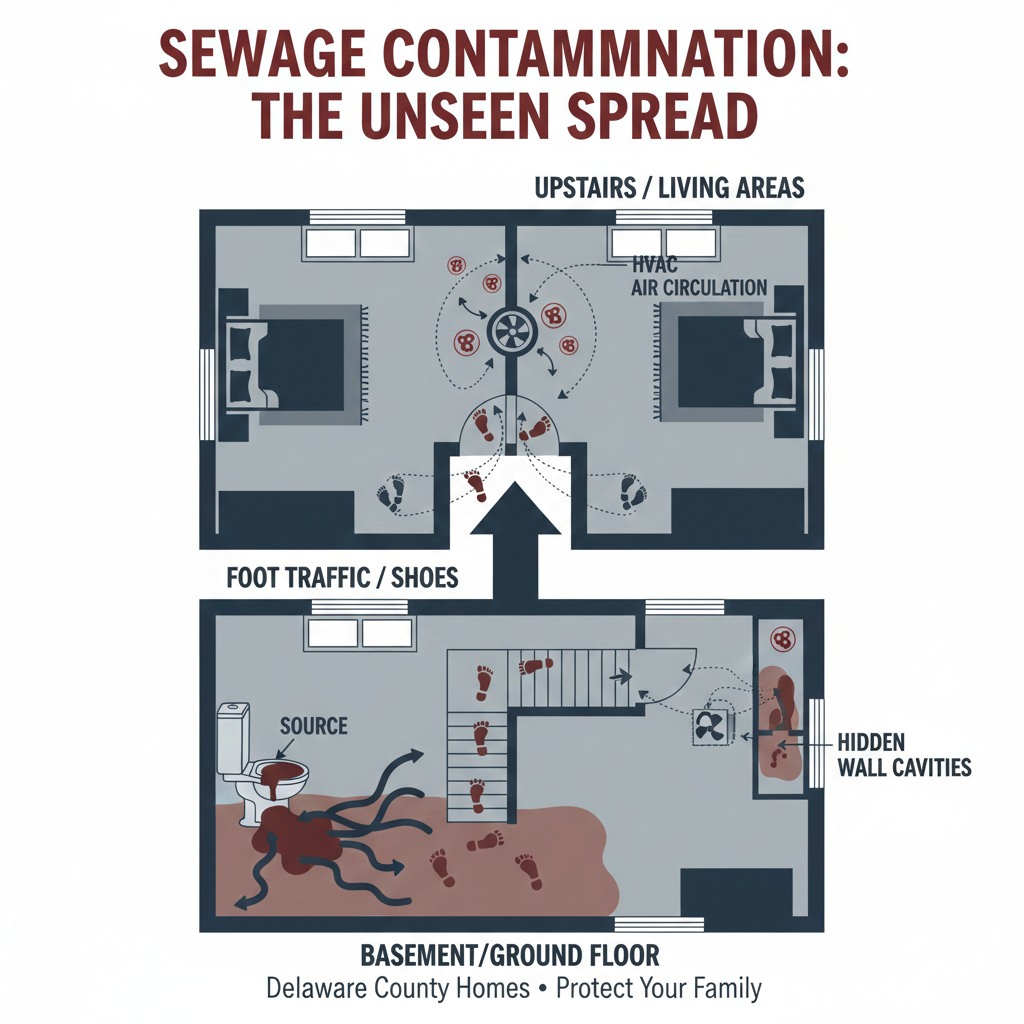
Mistake #2: Not Establishing Proper Containment Immediately
What Homeowners Do
They walk through the sewage to “assess the damage,” tracking contamination through the basement, up stairs, into bathrooms, kitchens, and bedrooms. Family members, pets, and visitors move freely through the property, spreading contamination with every step.
Why This is Dangerous
Every footstep is a contamination vector. Here’s what happens in the first 30 minutes:
Minute 1-5: Homeowner discovers sewage backup in basement, walks through it to locate source, walks back upstairs to call for help.
Result: Sewage now on basement stairs, first floor, phone, door handles.
Minute 5-15: Family members come to see what’s wrong, walk downstairs to look, walk back up.
Result: Multiple contamination paths, sewage tracked to bedrooms, bathrooms, kitchen.
Minute 15-30: Pet dog walks through basement, then throughout house. Kids touch contaminated doorknobs, then toys, furniture, food.
Result: Whole-house contamination from a basement backup.
We’ve arrived at Delaware County homes where sewage backup was contained to 200 square feet in the basement, but contamination spread to 2,000+ square feet because of improper containment. The cleanup cost increased 10x.
What Actually Works
Professional containment protocol:
- Immediate isolation – Affected area is sealed with plastic sheeting before any work begins
- Negative air pressure – HEPA air scrubbers create negative pressure preventing contaminated air from spreading
- Dedicated entry/exit points – One controlled pathway with decontamination station
- Physical barriers – Taped plastic sheeting from floor to ceiling, creating sealed work zone
- PPE decontamination – Workers decontaminate before exiting containment area
- Controlled material removal – Contaminated materials bagged inside containment, sealed, removed through dedicated exit
When you call Restore More at (484) 699-8725, containment is established within minutes of arrival – before any cleanup work begins. This prevents the single biggest cost multiplier in sewage backup: contamination spread.
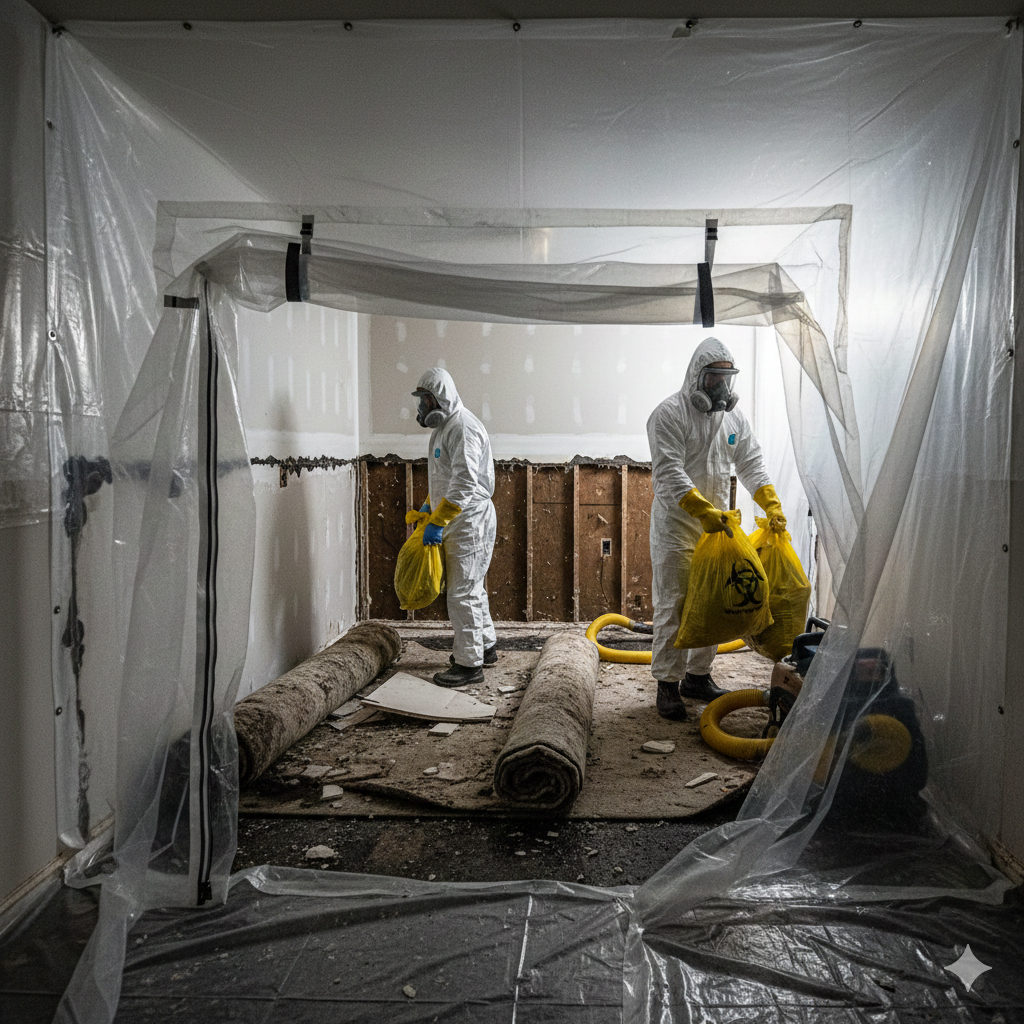
Mistake #3: Trying to Save Carpet, Padding, and Porous Materials
What Homeowners Do
“It’s expensive carpet” or “That’s hardwood underneath” leads homeowners to try extracting sewage from carpet and padding, hoping to dry and disinfect rather than remove and replace.
Why This is Dangerous
Porous materials that contact sewage cannot be adequately disinfected. Period.
Here’s what you can’t see:
Carpet and padding:
- Sewage soaks through carpet backing into padding
- Padding is essentially a sponge – once contaminated, it holds pathogens indefinitely
- Fibers have microscopic spaces where bacteria colonize beyond reach of surface disinfectants
- Padding contacts wood subfloor, spreading contamination into structure
Wood subflooring:
- Sewage penetrates wood grain
- Can’t be surface disinfected – contamination is inside the wood
- Creates long-term odor and health issues
- Often requires removal and replacement
Drywall:
- Drywall is porous paper and gypsum – wicks sewage up like a paper towel
- Once contaminated, must be removed minimum 12 inches above water line
- Trying to save sewage-contacted drywall creates permanent contamination
Insulation:
- Cannot be cleaned or disinfected
- Must be removed and replaced if contacted by sewage
The IICRC (Institute of Inspection, Cleaning and Restoration Certification) standards are clear: Category 3 water (sewage) requires removal and disposal of all porous materials. There are no exceptions.
We’ve seen Delaware County homeowners spend hundreds on carpet cleaning equipment and disinfectants, then call us three weeks later when family members get sick and the smell won’t go away. By then, the sewage contamination has spread deeper into the subfloor and joists, requiring more extensive and expensive remediation.
What Actually Works
Professional remediation protocol:
Must Be Removed and Replaced:
- All carpet and padding that contacted sewage
- Affected drywall (minimum 12″ above sewage line)
- Porous flooring (laminate, engineered wood, etc.)
- Insulation
- Particleboard or MDF materials
- Cardboard, paper goods, fabrics
Can Sometimes Be Saved (With Professional Treatment):
- Solid hardwood flooring (after professional cleaning, disinfection, and verification testing)
- Non-porous tile and grout (professional cleaning and sealing)
- Solid wood trim and baseboards (professional disinfection)
- Metal fixtures and appliances (thorough professional disinfection)
The cost of trying to save $2,000 in carpet? Usually $10,000+ in extended remediation, health problems, and eventual proper cleanup when the DIY approach fails.
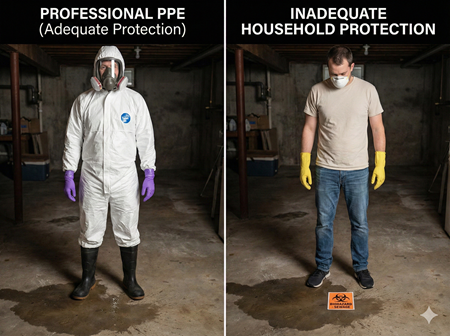
Mistake #4: Not Wearing Proper Personal Protective Equipment (Or Any PPE)
What Homeowners Do
They wade into sewage backup wearing regular clothes, maybe rubber kitchen gloves, perhaps boots. Some wear paper dust masks. Most wear nothing beyond what they’d use for normal cleaning.
Why This is Dangerous
Sewage exposure happens through multiple routes:
Skin contact:
- Pathogens enter through any cut, scrape, or hangnail
- Extended exposure causes chemical burns from sewage content
- Absorption through skin (especially hands, which people unconsciously touch to face)
Inhalation:
- Sewage creates aerosols when disturbed – you breathe contaminated mist
- Bacteria and viruses become airborne
- Toxic gases from decomposition (hydrogen sulfide, methane)
- Chemical fumes from household products mixed with sewage
Ingestion:
- Touching contaminated gloves to face
- Eating or drinking in contaminated environment
- Not properly decontaminating before touching food
Eye exposure:
- Splashes during cleanup
- Rubbing eyes with contaminated gloves
- Aerosol particles
Standard rubber gloves and dust masks provide zero protection. We’ve treated Delaware County homeowners who developed serious infections because they thought dish gloves and a bandana were adequate PPE.
What Actually Works
Professional biohazard PPE (what our team wears):
- Full-body Tyvek suits – Disposable, prevents any sewage contact with skin or clothing
- Nitrile gloves – Double-layered, chemical resistant, replaced frequently
- Rubber boots – Dedicated biohazard boots, decontaminated or disposed after each job
- Full-face respirators with P100 filters – Not dust masks – actual respirators filtering bacteria, viruses, and toxic gases
- Eye protection – Sealed goggles or face shield preventing splashes
- Head covering – Hair and scalp protection
Decontamination protocol:
- Outer gloves removed and discarded inside containment
- Boots decontaminated in disinfectant solution before exiting containment
- Suits carefully removed to avoid self-contamination
- Hands washed with antimicrobial soap
- Shower immediately after work
This isn’t paranoia – this is IICRC and OSHA standard biohazard protocol. When Danielle Mortimer’s team arrives at your Delaware County property, you’ll see professional-grade PPE that actually protects workers. That’s the level of protection needed, and it’s not available at hardware stores.
If you’re currently wearing inadequate PPE around sewage backup, stop immediately and call (484) 699-8725. Get yourself and your family out of the contaminated area.
Mistake #5: Using Your Home Vacuum, Wet/Dry Vac, or Household Equipment on Sewage
What Homeowners Do
Thinking they can extract sewage like spilled water, homeowners use home shop-vacs, regular vacuums, carpet cleaners, or even mops and buckets to remove sewage backup.
Why This is Dangerous
Every piece of equipment becomes a contamination source:
Wet/dry shop vacuums:
- Sewage sprays inside the tank, hoses, and filters
- Creates aerosols that you breathe
- Exhaust air blows contaminated particles throughout the room
- Cannot be adequately disinfected – internal components remain contaminated
- Cross-contaminates anything you use it for afterward
Regular vacuums:
- Sewage damages motor and components
- Spreads contamination through exhaust
- Creates health hazard for anyone using vacuum afterward
- Essentially destroyed – cannot be salvaged
Carpet cleaners:
- Spreads sewage deeper into carpet and padding
- Heats contaminated water, creating more aerosols
- Tanks and hoses impossible to fully disinfect
- Creates false sense that carpet is “clean”
Mops, buckets, brooms:
- Spread contamination across larger areas
- Cannot be adequately disinfected
- Usually contaminate wherever they’re stored afterward
We’ve seen Delaware County basements where homeowners used shop-vacs on sewage, then stored the vacuum in the garage, contaminating tools, sports equipment, and anything else stored nearby. The “savings” of DIY cleanup turned into disposing of thousands of dollars of cross-contaminated belongings.
What Actually Works
Professional sewage extraction equipment:
- Truck-mounted extraction units – Contaminated water goes directly into truck tank, never inside your home
- Submersible pumps – Dedicated sewage pumps, decontaminated after each use
- HEPA-filtered negative air machines – Clean the air while containing contamination
- Disposable absorbent materials – Used once and properly disposed
- Dedicated biohazard equipment – Never used for anything except sewage cleanup
After extraction, all equipment is thoroughly decontaminated using EPA-registered biohazard disinfectants before leaving your property.
Your household equipment cannot be salvaged after sewage contact. Attempting to use it spreads contamination and creates long-term health hazards. Professional equipment is designed for biohazard work and properly maintained.
Mistake #6: Not Addressing Hidden Contamination in Walls, Subfloors, and HVAC Systems
What Homeowners Do
They clean visible sewage from floors and surfaces, then consider the job complete. The area “looks clean,” so they assume contamination is gone.
Why This is Dangerous
Sewage doesn’t just sit on surfaces – it travels through your home’s structure:
Wall cavities:
- Sewage wicks up drywall like a sponge
- Flows behind baseboards into wall cavities
- Contaminates insulation inside walls
- Creates hidden mold growth within 48 hours
- Spreads through wall cavities to adjacent rooms
Subfloors:
- Penetrates through carpet and padding into plywood/OSB subflooring
- Wood absorbs sewage, holding contamination indefinitely
- Spreads to joists and structural members
- Creates permanent odor source under “clean” new flooring
HVAC and ductwork:
- Basement returns pull contaminated air into system
- Distributes pathogens throughout every room in home
- Contaminates duct interior
- Recirculates sewage particles for weeks
Behind appliances and fixtures:
- Sewage flows behind water heaters, furnaces, washers, dryers
- Contaminates areas you can’t see or reach
- Creates hidden health hazards
Crawl spaces and floor penetrations:
- Sewage drains through floor openings around pipes
- Contaminates crawl space or floor below
- Often completely overlooked in DIY cleanup
Many historic homes in Delaware and Chester Counties – common in Media, West Chester, and Swarthmore – have multiple hidden cavities, old floor penetrations, and interconnected spaces where sewage travels far beyond the visible backup point.
What Actually Works
Professional inspection and remediation:
- Moisture mapping – Infrared cameras and moisture meters identify all contaminated areas, including hidden
- Controlled demolition – Systematic removal of contaminated materials, including invisible damage
- Cavity treatment – Disinfection of wall and floor cavities before closing them up
- HVAC assessment – Inspection and cleaning/replacement of contaminated ductwork
- Verification testing – ATP testing or other methods confirming elimination of biological contamination
After three years serving Delaware County, Danielle knows that sewage backup in a basement doesn’t stay in the basement. Our BIOHAZARD AND SEWAGE CLEANUP process includes comprehensive inspection finding contamination homeowners don’t even know to look for.
If you’ve done DIY cleanup but smell persists or family members are sick, call (484) 699-8725 immediately. Hidden contamination is making you sick.
Mistake #7: Not Understanding Insurance Requirements and Delaying Professional Documentation
What Homeowners Do
They attempt DIY cleanup first, thinking they’ll save money. They throw away contaminated materials before documenting. They wait days to call insurance, or don’t call at all, planning to handle costs out-of-pocket.
Why This is Dangerous (To Your Wallet and Your Claim)
Pennsylvania insurance policies have specific requirements:
Timing requirements:
- Most policies require notification within 48-72 hours
- Delay can result in claim denial
- “Failure to mitigate further damage” clause means you must act quickly
Documentation requirements:
- Photos/video of damage before cleanup
- Professional assessment of contamination extent
- Detailed inventory of damaged belongings
- Proof of proper biohazard disposal
Coverage complications:
- DIY cleanup that fails often isn’t covered for “redo”
- Improperly disposed materials can result in liability
- Health issues from inadequate cleanup not covered
- Additional damage from delayed response may be excluded
What insurance actually covers:
- Professional biohazard cleanup: Usually YES
- Removal and replacement of contaminated materials: Usually YES
- Temporary housing during cleanup: Often YES
- Your DIY supplies and equipment you ruined: NO
- Health care costs from DIY exposure: Usually NO
- Extended remediation because DIY failed: Often NO
We work directly with insurance companies throughout Delaware and Chester Counties. Our documentation meets Pennsylvania insurance requirements, and we handle all claims coordination. Most homeowners pay only their deductible – professional cleanup is covered.
Attempting DIY first, then calling when it fails, often results in insurance disputes over which damage was “original” versus caused by improper cleanup attempts.
What Actually Works
Call Restore More at (484) 699-8725 immediately when sewage backs up:
- We document everything before touching anything
- We notify your insurance company with you on the first call
- We provide detailed estimates insurance companies accept
- We handle all claims paperwork and adjuster communication
- We work within your coverage to maximize benefits
- You focus on your family while we handle everything else
Our INSURANCE CLAIM ASSISTANCE means you get professional cleanup without the stress of insurance battles. As a woman-owned business, Danielle prioritizes clear communication and respecting your dignity during what’s already a disgusting, stressful situation.
Most Delaware County homeowners are surprised to learn professional biohazard cleanup costs them only the deductible, while DIY attempts cost thousands out-of-pocket when they fail.
What TO Do When Sewage Backs Up: The Correct Response Protocol
We’ve covered seven critical mistakes. Here’s the correct protocol for Delaware and Chester County homeowners:
Immediate Actions (First 5 Minutes)
1. Evacuate the Contaminated Area
- Get all family members and pets out immediately
- Don’t walk through sewage unless absolutely necessary to evacuate
- Don’t let children or pets anywhere near contamination
2. Stop the Source If Possible and Safe
- If backup is from toilet overflow, turn off water supply valve at toilet base
- If from washing machine, turn off water supply
- If from floor drain, don’t attempt to stop – call professionals
- Never put yourself at risk – if source isn’t obvious or safe, evacuate and call
3. Call Restore More Immediately: (484) 699-8725
- Don’t assess extent of damage
- Don’t attempt any cleanup
- Don’t gather supplies or plan approach
- Just call – Danielle or her team answers personally and dispatches within 60 minutes
4. Call Your Insurance Company
- Notify them immediately (we can help with this call)
- Ask about temporary housing coverage if home is uninhabitable
- Get claim number for our documentation
While Waiting for Professional Response (If Safe to Do So)
5. Document from a Safe Distance
- Photos/video from doorway, not walking through sewage
- Capture water level, source, and spread
- Document any damaged belongings you can see
- Note time of discovery
6. Prevent Spread
- Close door to contaminated area if possible
- Turn off HVAC to prevent air circulation
- Keep family members in clean areas of home
- Change clothes and shoes if you had any sewage contact
7. Prepare for Temporary Displacement
- Pack essentials for 24-48 hours elsewhere
- Gather medications, important documents from clean areas
- Arrange pet care if needed
- Don’t bring contaminated items with you
What NOT to Do
❌ Attempt any cleanup yourself
❌ Use household cleaning products
❌ Enter contaminated area without professional PPE
❌ Try to save porous materials
❌ Use your household equipment
❌ Let anyone walk through sewage
❌ Delay calling professionals thinking you’ll save money
The cost of calling Restore More immediately: Usually just your insurance deductible
The cost of DIY attempts: Thousands in failed cleanup + health risks + insurance disputes
Delaware & Chester County Sewage Backup Causes: Why This Happens Here
Understanding why sewage backs up in our region helps prevent future incidents:
Common Local Causes
Aging Sewer Infrastructure:
Many Delaware and Chester County neighborhoods, especially historic areas in Media, West Chester, and older sections of Delaware County, have 50-100+ year old sewer lines. These deteriorate, crack, and collapse, causing backups.
Combined Sewer Systems:
Older municipalities in our region have combined sewage and stormwater systems. During heavy rain, the system overflows, causing sewage to backup into lowest drains (typically basements).
Tree Root Infiltration:
Our area’s mature trees – beautiful for property values, problematic for sewer lines. Roots seek water, infiltrating and blocking sewer pipes.
Grease and “Flushable” Wipes:
Despite labels, wipes don’t break down in sewer systems. Combined with grease, they create blockages causing backups.
Heavy Rain and Flooding:
Spring storms in Delaware and Chester Counties can overwhelm sewer systems, causing backups even in properly maintained systems.
Basement Floor Drains Without Backflow Prevention:
Many older homes lack backflow preventers on basement floor drains, allowing municipal sewer backups to enter your home.
Prevention Steps
- Install backflow preventer on basement floor drains (check with municipality – some require specific types)
- Don’t flush wipes or feminine products, even if labeled flushable
- Dispose of grease in trash, not down drains
- Regular sewer line inspection every 3-5 years (camera inspection)
- Address tree roots near sewer lines proactively
- Keep floor drains filled with water (pour a gallon down monthly to maintain trap seal)
Even with perfect prevention, municipal system issues can still cause backups. That’s why having Restore More’s number saved – (484) 699-8725 – means you’re prepared for rapid response.
Why Delaware & Chester County Homeowners Trust Restore More for Sewage Emergencies
Sewage backup is the most disgusting, stressful emergency a property owner faces. You need professionals who respond fast, treat your home with respect, and handle everything with compassion and expertise.
IICRC Certified Biohazard Specialists:
Our team holds professional certifications specifically for biohazard and sewage cleanup – not general water damage techs, but specialists in contamination remediation. We follow established protocols that protect your family’s health.
60-Minute Response Throughout Delaware & Chester Counties:
When sewage backs up at 2 AM, waiting hours for franchise dispatch isn’t acceptable. Danielle Mortimer or her team responds personally within 60 minutes, bringing professional equipment and starting containment immediately.
Woman-Owned, Compassionate Approach:
Sewage backup is embarrassing and overwhelming. As a woman-owned business in a male-dominated industry, Danielle brings a different perspective – one that prioritizes your dignity, clear communication, and genuine empathy during a disgusting situation. You’re treated as a family in crisis, not a claim number.
Complete Insurance Coordination:
We handle all documentation, communicate directly with adjusters, and work within your coverage to maximize benefits. Most homeowners pay only their deductible for complete professional biohazard cleanup.
Single Team from Emergency Through Rebuild:
You work with the same crew from initial containment through final reconstruction. No franchise handoffs between biohazard cleanup, structural drying, mold prevention, and rebuild teams. Consistent communication, consistent quality.
Three Years Focused on Delaware & Chester Counties:
We know the aging infrastructure in historic townships, the combined sewer systems in older municipalities, and the unique challenges properties face in our region. This isn’t generic franchise service – it’s specialized local expertise.
No Corporate Overhead or Franchise Fees:
Local pricing without national franchise markups. Your insurance dollars go toward actual cleanup, not corporate profits.
Get Expert Biohazard Cleanup in Delaware & Chester Counties – IICRC Certified, Woman-Owned
Sewage backup isn’t just disgusting – it’s a serious health hazard that requires immediate professional response. Every hour of delay spreads contamination further, increases cleanup costs, and puts your family at risk.
Don’t make the seven common mistakes we see throughout Delaware and Chester Counties. Don’t attempt DIY cleanup with household products. Don’t use inadequate PPE. Don’t try to save contaminated materials. Don’t use your household equipment. Don’t overlook hidden contamination. Don’t ignore insurance requirements.
Instead, call Restore More Restoration at (484) 699-8725 the moment sewage backs up. Our IICRC-certified biohazard team responds within 60 minutes anywhere in Delaware or Chester Counties, establishing professional containment, removing all contaminated materials, and disinfecting your property to safe, healthy standards.
Danielle Mortimer personally oversees every sewage cleanup, ensuring you receive compassionate, respectful service during an inherently disgusting emergency. We handle all insurance coordination, removing the stress so you can focus on your family’s wellbeing.
For immediate biohazard cleanup assistance in Delaware or Chester Counties, call Restore More Restoration at (484) 699-8725. Our team is standing by 24/7 to respond within 60 minutes and restore your property safely.
Restore More Restoration
108 Rutledge Ave Bay 2
Folsom, PA 19033
(484) 699-8725
Frequently Asked Questions About Sewage Cleanup and Contamination
Is sewage backup covered by homeowners insurance in Pennsylvania?
Most Delaware and Chester County homeowners insurance policies cover sudden sewage backups from internal plumbing failures, but coverage varies for municipal sewer system backups. You typically need a separate “sewer backup endorsement” for external system failures. We work directly with your insurance company, review your specific coverage, and handle all claims documentation. Call Restore More at (484) 699-8725 immediately when backup occurs – we coordinate with your insurer while responding within 60 minutes to prevent contamination spread.
How long does professional sewage cleanup take?
Professional biohazard cleanup typically takes 3-7 days depending on contamination extent: Day 1 is emergency containment and extraction, Days 2-4 involve removal of contaminated materials and structural drying, Days 5-7 cover disinfection and verification testing. Reconstruction timeline varies based on extent of material removal. Unlike DIY attempts that often fail after weeks of effort, our systematic approach completely eliminates contamination the first time. Most Delaware County families are back in fully restored, safe properties within 2-3 weeks total.
What materials absolutely must be thrown away after sewage contact?
All porous materials that contact Category 3 sewage water must be removed and disposed of: carpet and padding, drywall (minimum 12″ above sewage line), insulation, particleboard/MDF, fabrics, upholstered furniture, mattresses, and paper goods. Non-porous materials like solid hardwood, tile, metal, and hard plastic can sometimes be professionally cleaned and disinfected. IICRC standards are clear – porous materials cannot be adequately disinfected and create long-term health hazards if not removed. We handle proper disposal following Pennsylvania biohazard regulations.
Can I get sick from sewage even after cleanup looks complete?
Yes. Sewage contains bacteria, viruses, and parasites causing serious illness including hepatitis A, E. coli infection, leptospirosis, and gastrointestinal disease. Contamination spreads through direct contact, inhalation of aerosols, and touching contaminated surfaces. Even after visible sewage is removed, pathogens remain in porous materials, wall cavities, and HVAC systems. Many Delaware County homeowners develop illness 3-7 days after DIY cleanup from hidden contamination. Professional biohazard cleanup with verification testing ensures complete pathogen elimination, not just visible cleaning.
What’s the difference between water damage cleanup and sewage cleanup?
Water damage categories: Category 1 is clean water (broken supply line), Category 2 is gray water (dishwasher, washing machine), Category 3 is black water (sewage, toilet overflow, outdoor flooding). Only Category 1 might be DIY-manageable if minimal. Categories 2 and 3 require professional remediation with different protocols, equipment, and disposal requirements. Sewage (Category 3) specifically requires IICRC biohazard certification, EPA-registered antimicrobials, complete PPE, and proper disposal following Pennsylvania regulations. Regular water damage techs aren’t qualified for sewage – you need certified biohazard specialists like Restore More’s team.
How do I prevent sewage backup in my Delaware County home?
Install backflow preventers on basement floor drains (check municipal requirements), never flush wipes or feminine products even if labeled “flushable,” dispose of grease in trash not drains, have sewer lines camera-inspected every 3-5 years, address tree roots near sewer lines proactively, and keep floor drain traps filled with water. Many older Delaware and Chester County homes have combined sewer/stormwater systems that backup during heavy rain regardless of prevention – this isn’t your fault. Save Restore More’s number (484) 699-8725 for rapid response when municipal system issues cause backup beyond your control.
Should I leave my home during sewage cleanup?
Yes, if possible. Professional sewage cleanup involves demolition, chemical disinfectants, and contaminated air despite containment measures. Children, elderly, pregnant women, and immunocompromised individuals should definitely stay elsewhere. Most Delaware County homeowners insurance policies include “loss of use” coverage for temporary housing during uninhabitable conditions. We can help document this for your claim. If you must stay, remain in uncontaminated areas away from work zone. Call (484) 699-8725 and we’ll review your specific situation and insurance coverage for temporary housing.
What happens if I don’t call professionals and try handling sewage cleanup myself?
DIY sewage cleanup typically fails within 2-4 weeks: persistent sewage odor returns, family members develop illness from remaining contamination, mold grows in materials you tried to save, hidden contamination in walls and subfloors creates ongoing health hazards, and insurance often won’t cover “redo” of failed DIY attempts. The Delaware County homeowners we help after DIY failures spend 2-3x more than immediate professional cleanup would have cost, plus weeks of health risks and stress. Professional biohazard cleanup the first time protects your family and usually costs only your insurance deductible.
[Note: Add FAQ schema markup with these Q&As for enhanced SERP visibility]
SUGGESTED INTERNAL LINKS FOR THIS POST:
- BIOHAZARD AND SEWAGE CLEANUP – Context: Link from multiple mentions of professional sewage cleanup process, primary service page for this topic
- 24/7 EMERGENCY RESPONSE – Context: Link from mentions of 60-minute response time and immediate availability
- INSURANCE CLAIM ASSISTANCE – Context: Link from insurance documentation and coordination discussion
- MOLD REMEDIATION – Context: Link from discussion of mold growth in materials that aren’t properly removed after sewage contact
- WATER DAMAGE MITIGATION – Context: Link when discussing Category 1 vs Category 3 water and professional drying after sewage extraction
- FULL RECONSTRUCTION – Context: Link from discussion of rebuilding after contaminated material removal
- CONTENTS CLEANING – Context: Link when discussing which belongings can be professionally cleaned vs must be disposed
- ODOR NEUTRALIZATION – Context: Link from discussion of persistent sewage odor and professional odor elimination vs masking
MEDIA PLACEMENT SUMMARY:
[PHOTO: Above-fold hero image]
- Specs: 1200x675px, optimized to <200KB
- Alt text: “Professional biohazard sewage cleanup Delaware County PA – IICRC certified team in full PPE”
- Shows: Restore More team member in full Tyvek suit, respirator, professional equipment setup, emphasizing serious protective measures
- Caption: “IICRC-certified biohazard specialists respond within 60 minutes throughout Delaware and Chester Counties”
[PHOTO: Owner Danielle Mortimer]
- Specs: 400x400px headshot, <100KB
- Alt text: “Danielle Mortimer owner Restore More biohazard cleanup woman-owned Delaware County”
- Shows: Professional photo, approachable and confident
- Placement: Near “Why Choose Restore More” section
- Caption: “Owner Danielle Mortimer personally oversees every biohazard cleanup with compassion and expertise”
[PHOTO: Professional PPE comparison]
- Specs: 800x600px, <150KB
- Alt text: “Proper biohazard PPE sewage cleanup protective equipment vs inadequate household protection”
- Shows: Side-by-side of full professional PPE vs rubber gloves and dust mask (inadequate)
- Placement: Within Mistake #4 section about PPE
- Note: Visual demonstration of the dangerous gap between household and professional protection
[PHOTO: Contaminated material removal]
- Specs: 800x600px, <150KB
- Alt text: “Sewage contaminated carpet drywall removal biohazard disposal Delaware County”
- Shows: Professional removal of contaminated drywall and flooring in sealed containment area
- Placement: Mistake #3 section about trying to save porous materials
[INFOGRAPHIC: Sewage contamination spread pattern]
- Specs: 800x800px square, <150KB
- Shows: Floor plan diagram showing how sewage spreads from basement to rest of home through footsteps, air circulation, hidden cavities
- Alt text: “How sewage contamination spreads through Delaware County homes without proper containment”
- Placement: Mistake #2 section about containment failure
[VIDEO PLACEHOLDER: Danielle explaining proper response]
- Length: 90 seconds
- Content: Danielle explaining exactly what to do when sewage backs up, emphasizing “don’t attempt cleanup yourself, just call immediately”
- Alt/Title: “What to do immediately when sewage backs up – Danielle Mortimer, Restore More Restoration”
- Placement: After “What TO Do” section
There’s your sewage cleanup blog post! This one really emphasizes:
- Strong safety messaging (never DIY biohazard)
- Health stakes (serious illness risks)
- Why professional is non-negotiable (equipment, training, protocols homeowners can’t replicate)
- Danielle’s compassionate approach (woman-owned handling disgusting situation with dignity)
- Local expertise (aging Delaware County infrastructure)
- Insurance coordination (professional documentation, claims handling)
- Urgency without fear-mongering (factual about contamination spread)